
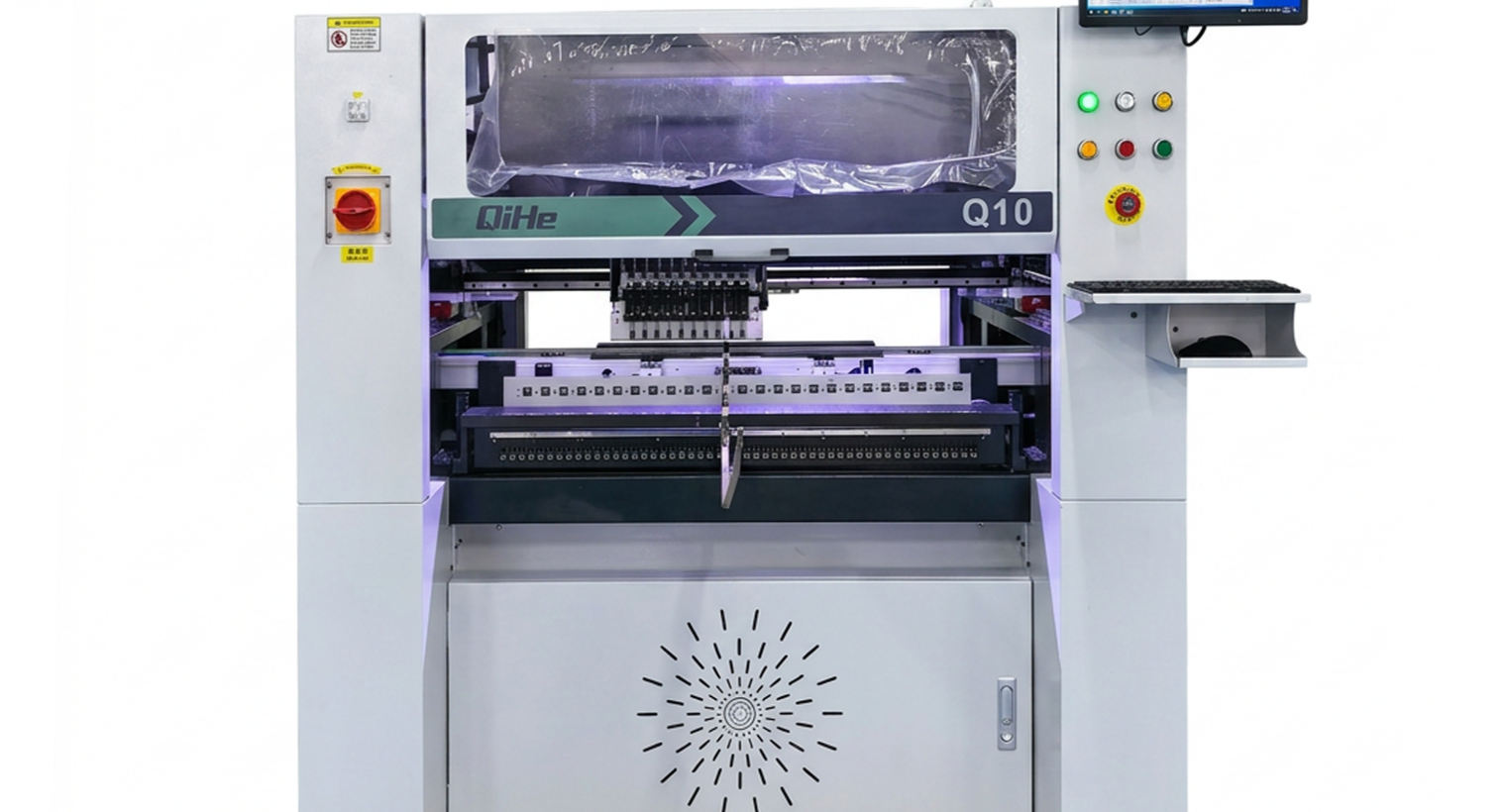
How to Read Pick and Place Machine Specs Correctly: CPH, Accuracy & Repeatability
When you shop for an SMT pick and place machine, you will quickly notice every supplier lists flashy pick and place machine specs: 80,000 CPH, ±0.02 mm accuracy, ultra-high speed. Many buyers take these parameters at face value, only to find the real output is far lower after installation.
If you are running a small EMS workshop, prototype lab, or scaling up electronic assembly, understanding what these specs really mean will help you avoid overspending and select a machine matched to your BOM mix.
1. What is CPH (Components Per Hour)?
CPH stands for Components Per Hour, the most widely used throughput indicator for chip mounters.
It is critical to know: published CPH is almost always measured under ideal lab conditions. Manufacturers usually test with simple, uniform small passive components (0402 resistors and capacitors), optimized PCB layout, no feeder change, no program switch, and continuous feeding.
Real production CPH will drop significantly when:
- You mix ICs, connectors, aluminum capacitors and tiny 0201 parts on one board
- Frequent product changeover is required
- Operators need to refill tape feeders or replace trays
- PCB size is large and fiducial recognition takes extra time
For reference:
- Benchtop pick and place: 5,000–25,000 real CPH, perfect for prototyping and low batch
- Mid-range modular mounter: 25,000–60,000 real CPH for mixed SMT jobs
- High volume dedicated lines: 60,000+ CPH for simple passive-heavy boards
Do not chase the highest CPH blindly if your business is high-mix, small-batch electronics. Changeover time often kills your overall line efficiency more than raw placement speed.
2. Accuracy vs Repeatability: They Are Not the Same
This is the most common misunderstanding among SMT buyers.
- Accuracy: How close the machine can place a component to the ideal target coordinate. It covers X/Y offset and rotation error.
- Repeatability: How consistent the machine performs over hundreds or thousands of placements. It describes whether the machine can hit the same spot reliably every time.
A machine can have good repeatability but poor accuracy if it drifts after thermal expansion or loses calibration. For fine-pitch IC, QFP, BGA and 01005 components, repeatability is just as important as nominal accuracy.
General selection benchmark:
- 0603 / 0805 basic resistors & capacitors: ±0.05 mm accuracy is enough
- 0402, small SOT: ±0.03 mm recommended
- 0201, 0.4 mm QFP, fine pitch IC: ±0.02 mm or better with visual fiducial correction
Vision system is the foundation of stable placement accuracy. Machines without on-board vision correction will struggle with slightly warped PCBs or tape component offset.
3. Other Pick and Place Machine Specs You Should Not Ignore
Nozzle & Feeder Compatibility
The speed and accuracy are useless if the machine cannot run your component packages. Check supported component range, nozzle types, electric feeder capacity and tray station options before purchase. Electric feeders deliver far lower pick-failure rates than pneumatic feeders for tiny chips.
PCB Size & Board Handling
Check maximum and minimum PCB dimension, board thickness and warpage tolerance. If you assemble long LED boards or thick power PCBs, this spec will become a hard limit.
Software & File Compatibility
Confirm it can read your centroid files from Altium, KiCad or other PCB design tools. Smooth program import reduces NPI setup time drastically.
4. Quick Checklist Before You Compare Quotations
✅ Ask suppliers whether the CPH number is theoretical or actual mixed-batch output ✅ Confirm accuracy definition: single point placement or full IPC-9850 test standard ✅ Ask about thermal compensation for long-run temperature drift ✅ Check spare nozzle, feeder availability and overseas after-sales support ✅ Match specs to your typical product mix instead of benchmarking the fastest model
Final Words
Pick and place machine specifications are not just numbers on a datasheet. The best machine is not always the fastest one; it is the one that maintains stable yield, short changeover time and low downtime for your specific PCB products.
If you need a pick and place machine for high-mix low-volume SMT assembly, QiHe SMT provides flexible benchtop and full-automatic chip mounters with reliable vision systems and local overseas technical support.
FAQ:
Q: Is higher CPH always better? A: No. High CPH models are designed for simple mass production. For high-mix jobs, changeover time and feeder stability matter more.
Q: What accuracy do I need for 0201 components? A: We recommend ±0.02~±0.03 mm placement accuracy with visual recognition.
Q: Can accuracy stay stable after long hours of running? A: It depends on motion control, thermal compensation and regular calibration. Our QM series adopts ARM+FPGA motion control to reduce thermal drift during continuous operation.
 English
 Chinese